I’m half Czech. I love music and I’m drawn to art and design. I like new, shiny tech things.
So when I decided to build a personal digital agent, I named it Motivka. It’s a nod to “motif,” the recurring pattern in music and art, suffixed with “ka,” the Czech diminutive for something small and endearing. It’s my appreciation for Czech creatives who came before me and used motifs to create something incredible: Alfons Mucha, Antonín Dvořák, and Jan Švankmajer, to name a few.
But why build a personal agent at all? To answer that, I need to take you on a quick road trip to explain how we got here.
The human computer interface
Here’s something I find fascinating about the history of computing: the biggest leaps in value haven’t been the result of a breakthrough in the underlying capability. No, they were driven by the interface.
Before the rise of the personal computer, the terminal gave researchers and military personnel the ability to communicate instantly, store information and perform complex calculations. Valuable, but limited to small circles who had access to the technology and could speak the machine’s language.

Then came the personal computer, swapping the terminal for a graphical user interface and a mouse. Suddenly, people were designing posters, playing video games and editing documents, all without needing to think about the complicated machine code underneath. Militaries adopted it, then universities adopted it, then workplaces, and finally it arrived in homes.
The internet connected these machines together. Early on, it was a mess. You had to know the exact address of a webpage to find it, navigating through forums of offensively unusable hyperlink directories. Google changed that with a simple search bar, turning the chaos of the web into something navigable, a simple text input. To give you a quick technical lesson: they used an algorithm to index and rank websites, then gave us an interface to query it. That search bar was arguably Google’s most important invention, the moment it became an agent.

It’s interesting to think about major advances in technology and other parts of our world in this framework. Someone takes something powerful but inaccessible and gives it an accessible interface that ordinary people can use.
Keep that pattern in mind.
Job displacement is coming
Every one of these shifts displaced workers. Bookkeepers, secretaries, typesetters, mathematicians, switchboard operators. There was even a time when “computer” referred to the job title, not the device. You might remember the film Hidden Figures, whose real-life heroes (all women) manually performed complex calculations to help launch a rocket to the moon.
But displacement is a natural byproduct of innovation. Instead of tilling fields by hand, we used tractors. Instead of washing clothes by hand, we got washing machines. Instead of performing maths by hand, we can program. Components within a process become commoditised and lose value as new roles evolve to meet new needs.
The agricultural playbook
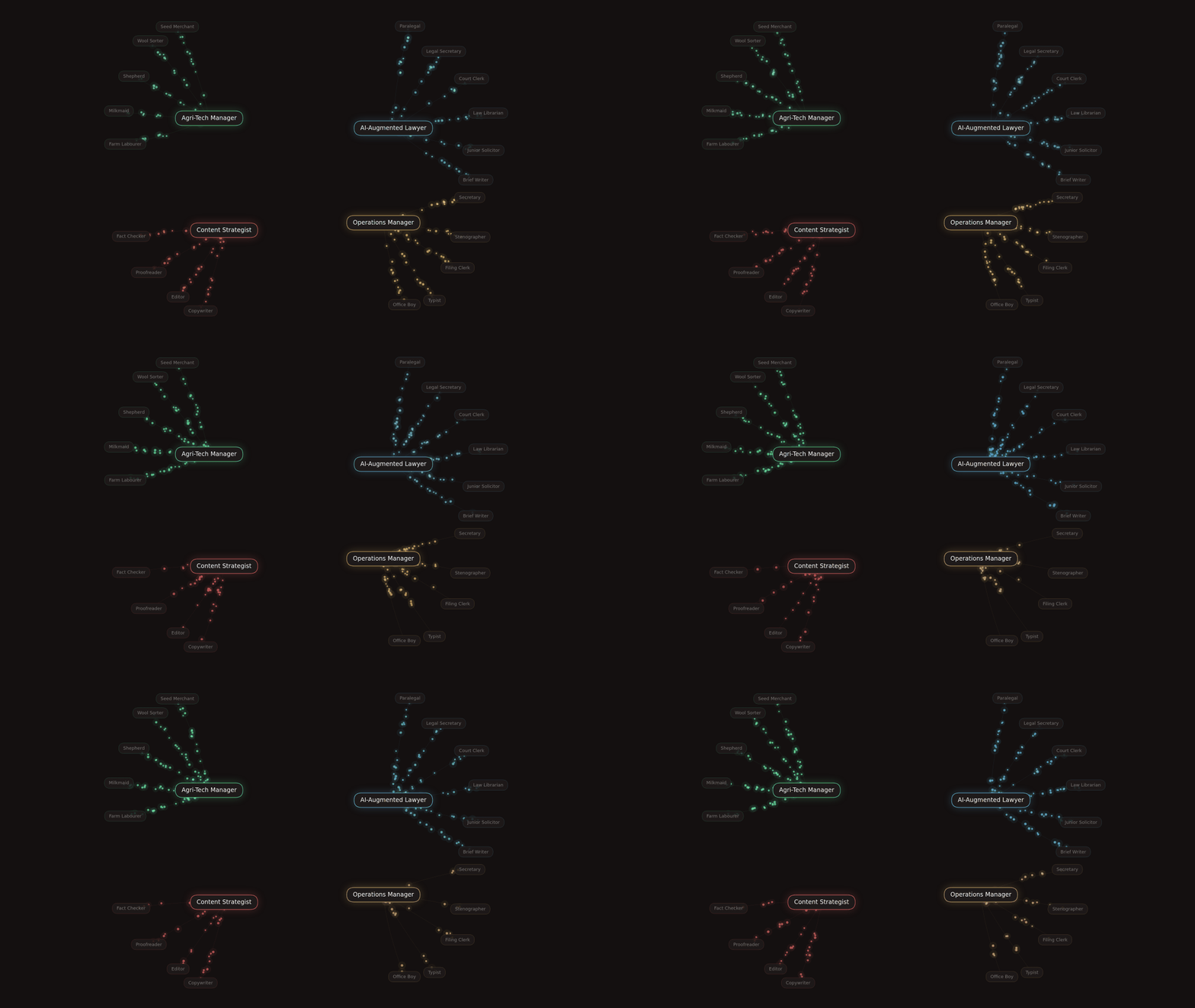
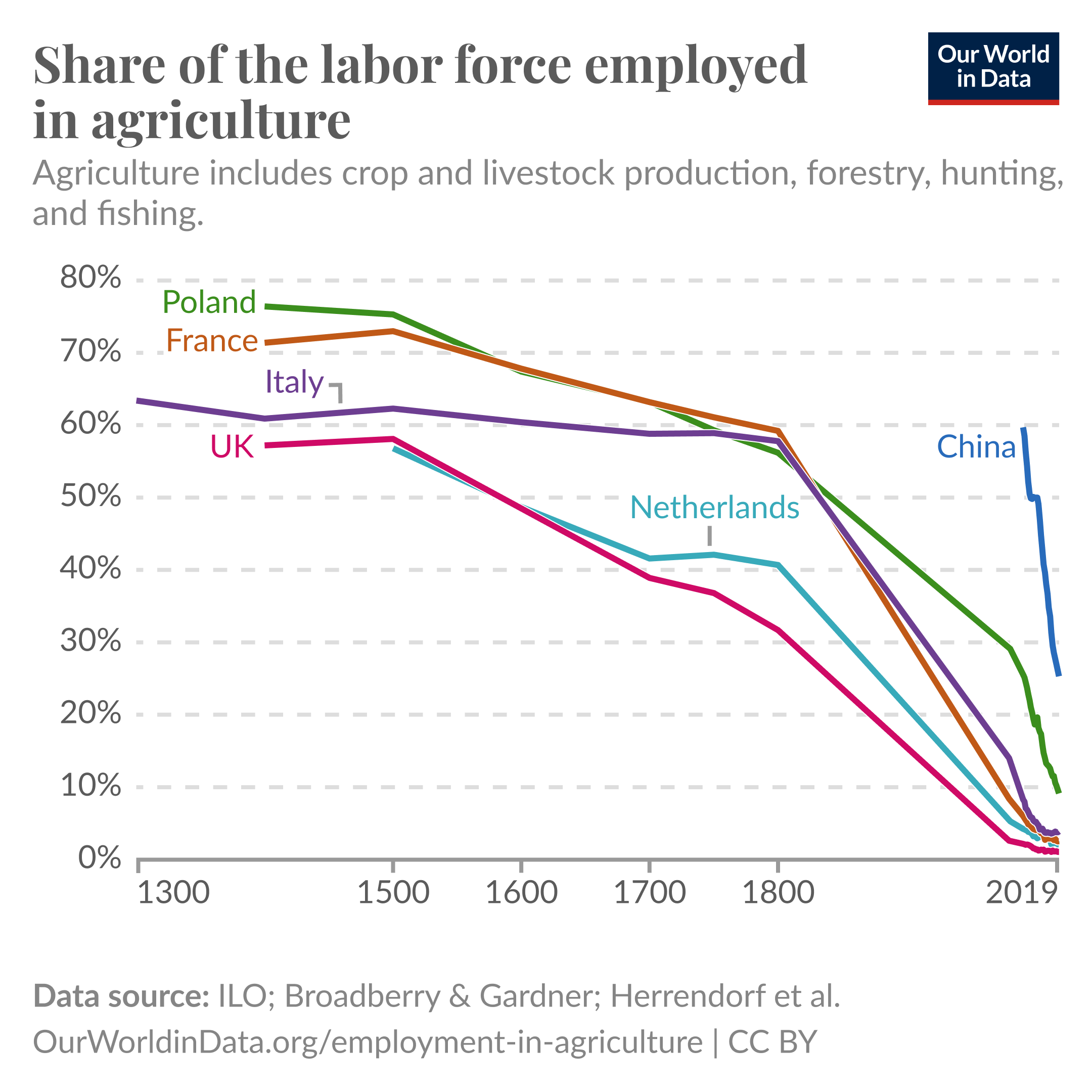
The agricultural system is a good case study for what’s coming next. Human workers used knowledge of farming practices, weather and genetics alongside physical tools like cows, tractors, shovels; to produce food at scale. Today, down from 80% in some countries, less than 10% of the global population works in agriculture, using automatic milking machines, driverless tractors, disease detection cameras and drone crop spraying. Look to China for an example of all this in practice. These tasks are now part of roles that were once occupied by a human worker.
Today, the most valuable farms might do things differently. My guess is they have something special in their context or tooling; a rare cattle breed providing premium tasting beef or dairy, specialised crops resistant to the harsh elements of a dry country, a unique climate where certain plants can grow. Something that can’t be easily commoditised.
The difference between agriculture’s transformation and what’s happening now? That took over 200 years. We might be looking at 5 to 10.
Context, tools and agents
To explain what I mean by “agent,” let me break it down simply, in the way that I am currently thinking about it.
Context is stored information. Ideas, memories, knowledge, values. It can be public (a blog, a features page, the human genome) or private (a diary, a codebase, your DNA).
Tools are resources you can take action with. Your body, a computer, a musical instrument. Often useless without context.
An LLM is a reasoning engine. It interprets context and makes decisions on how to act. A brain without a body. On it’s own it can think but it can’t actually do anything.
An agent is what you get when you combine context and tools with an LLM through an accessible interface. It creates value within it’s system by meeting the needs and wants of other agents.
Here are a couple of examples to make this concrete:
With the knowledge of a piece of music (context), a person can pick up a violin (tool) and record a track (context). This creates value because someone else might want to listen to it using their preferred interface.
With the knowledge of identifying mushrooms and the ability to code (context), someone can sit at a computer (tool) and build a mushroom identification app (tool). That’s valuable because another person might want to use it foraging to figure out which mushrooms are safe to eat.
As agents emerge, we abstract away the need for the raw context and tools underneath. You don’t need to learn violin to enjoy music. You don’t need to study mycology if you can download an app.
That’s human evolution.
You are training someone else’s agent
With all that in mind, we’re now in the middle of the next interface shift. Companies like Anthropic, OpenAI and Google have figured out how to build an interface to the system of human knowledge and software tools, effectively agentifying it. Specifically, this began with the launch of ChatGPT by OpenAI, nearly 5 years after the paper describing the underlying technology was published. Maybe by accident, this has also created a self-improvement flywheel through the generation of more knowledge.
These agents are impressive, and each interfaces with the world slightly differently. For example, each company has an LLM trained on a different subset of the human corpus, therefore, each has a different perspective. In my subjective experience: Claude leans creative and is strong at coding; ChatGPT is also a great coder, but tends to be supportive and eager to help in a weird sycophantic way; Gemini is deeply knowledgeable but can get lost in the details; Grok takes contrarian angles for the sake of it.
Everyone’s experience may differ.
But here’s the thing, in order to appeal to the masses, these models are generalised for the wider population. They’re not tuned for you and your context. They don’t have access to your tools. They don’t think the way you think. They don’t share your biases on particular topics.
As smaller, faster, more powerful open-source models continue to emerge, it’s becoming significantly easier to build personalised agents that communicate like us, reason like us, and view the world the way we do.
And that’s why I’m building Motivka
Just like knowing how to farm, fish, read or count was once essential for bartering at a local market, developing agency by building your own context and tools, will be an important skill as the way we interface with our systems changes. The good news is it will only get easier to do this.
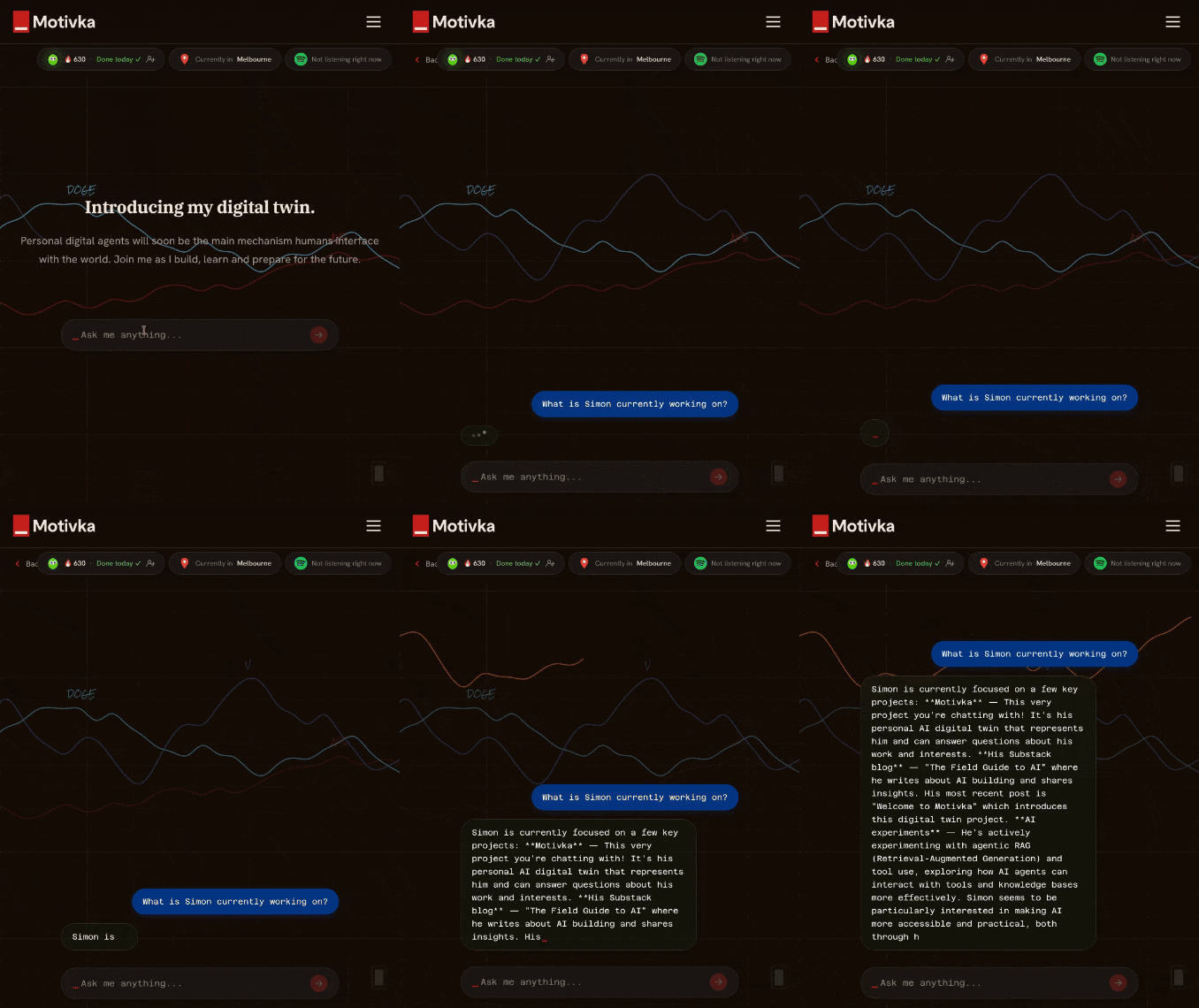
I believe we’re heading towards a world where most of our digital interactions happen at an agentic level. Each of us will have personal agents trained on our knowledge and capabilities, communicating on our behalf with a network of specialised agents in law, medicine, technology and beyond.
Carl Sagan once suggested humans might be the universe trying to discover itself. I reckon building a personal agent is a part of that, a way of encoding who you are, what you know and how you see the world into something that can act within an increasingly complex system. We might be experiencing the handover of the baton between humans and AI human cyborgs in the race to understanding the universe. I’ll explore that thread more in a future piece where I explore the seminal play that introduced the term Robot to the world.
Motivka is my version of this. I’m training it on my context, building and connecting it to my tools, and designing to interface with the world, in a way that feels like me.
Now, what about yours?
Here’s my challenge to you: start thinking about what your personal agent might look like.
What context would you give it? Your expertise, your values, your taste? What tools or workflows would it need access to? How would it represent you in a conversation or project you’re not part of?
You don’t need to build it tomorrow. But the people who start thinking about this now will have a serious advantage when the interface shifts again.
There will be risks
In naming Motivka, it wasn’t lost on me that the word Robot originates from Czech. This play from 1920 described the uprising of a class of Robots made from artificial flesh and bone, whose only purpose was to serve. They were indistinguishable from humans, with the lack of original thoughts the only difference, eerie similarities with today’s agents. The Robots eventually rebelled, leading to the extinction of the human race.
If you want to follow along as I build Motivka in public, you can find me on Instagram or at motivka.com which will act as my first foray into an interface .
Cheers!